
401(k) vs SEP IRA: Best Choice for Small Businesses
Tax Planning, Small Business Retirement, 401(k) vs SEP IRA
Lumenor Advisory Group Tax & Accounting Intelligence Brief – 401(k) vs SEP IRA for Small Businesses in 2026
In this edition of the Lumenor Advisory Group Tax & Accounting Intelligence Brief, we examine small business 401k vs SEP IRA options in 2026—focusing on contribution structures, employee impact, tax planning, and how to choose a retirement plan that supports long‑term business growth.
401(k) and SEP IRA: The Core Differences for Small Businesses
For many owners, the first question is simply SEP IRA vs 401k: which structure fits my business today and five years from now? Both are powerful tools for a business owner retirement strategy, but they are built around different assumptions about employees, cash flow, and administrative capacity.
A 401(k) is a flexible, employer‑sponsored plan allowing employee salary deferrals and potential employer contributions. It can be set up as a traditional multi‑employee plan or as a Solo 401(k) for owner‑only businesses.
A SEP IRA (Simplified Employee Pension) is an employer‑funded IRA arrangement, generally easier to administer, but every eligible employee must receive the same contribution percentage of compensation.
In 2026, both structures can support substantial savings, but they handle contributions and employee participation very differently—key considerations when selecting a retirement plan for small business owners.
Contribution Structures and 2026 Retirement Limits
Understanding small business retirement contribution limits is central to effective tax planning retirement strategies. While exact IRS limits can adjust annually, current guidance for 2026 provides a useful planning framework.
401(k) and Solo 401(k) Contributions (2026 Snapshot)
Employee deferrals: Up to approximately $24,500 in 2026, with an additional catch‑up of about $8,000 for those age 50 and older, bringing potential deferrals to around $32,500.
Total contributions (employee + employer): Up to about $72,000 per participant, subject to IRS rules and compensation caps (IRS Publication 560).
A Solo 401k vs SEP IRA comparison is especially important for self‑employed owners with no staff. Solo 401(k)s allow you to contribute both as “employee” and “employer,” potentially reaching the full defined contribution limit more efficiently at modest income levels, while also offering Roth and loan features in many cases.
SEP IRA Contributions (2026 Snapshot)
Employer‑only contributions: Up to 25% of eligible compensation, capped at about $72,000 per participant in 2026 (DOL small business guidance).
The same percentage must be contributed for all eligible employees, including the owner, which can significantly increase total outlay as your team grows.
In summary, both plans offer high ceilings, but a 401(k) spreads funding between employees and the employer, while a SEP IRA concentrates the funding obligation entirely on the business.
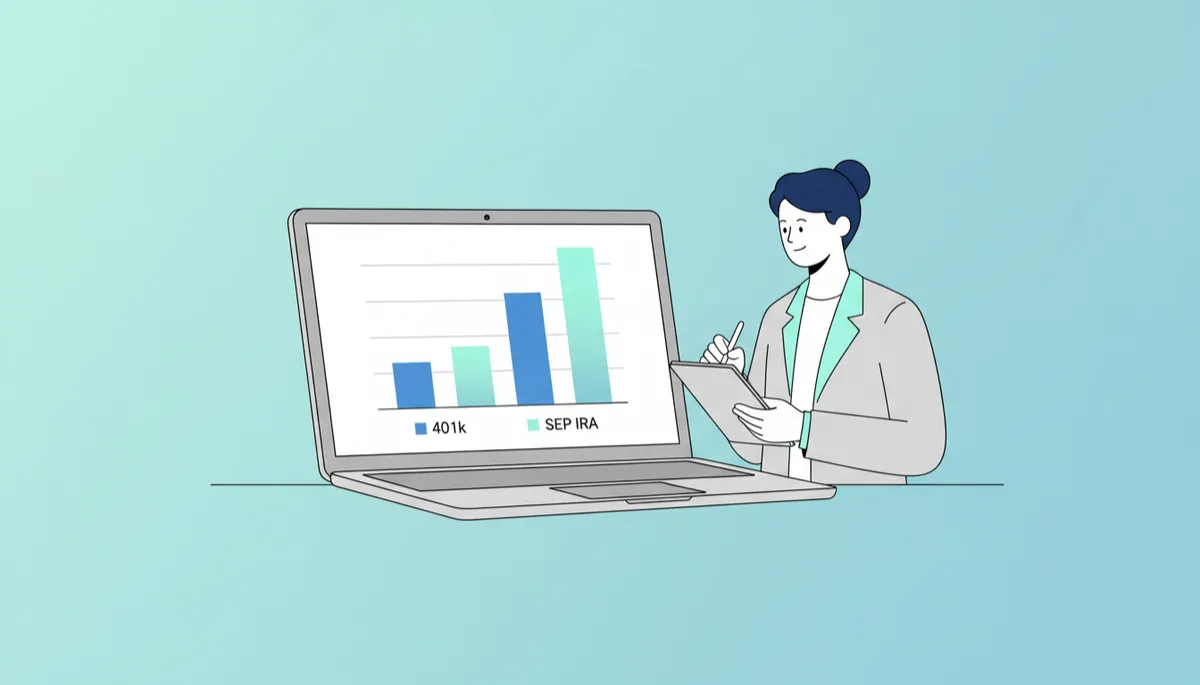
Higher contribution limits can accelerate owner wealth while supporting competitive employee benefits.
Employee Considerations and Plan Design Trade‑Offs
Employee impact is often the deciding factor when weighing employee retirement benefits through a small business 401k vs SEP IRA. The right choice can enhance retention, support recruiting, and align compensation with your culture.
401(k) plans: Employees can defer part of their own salary, often with pre‑tax or Roth options. Employer contributions can be discretionary, matching, or profit‑sharing based, and vesting schedules can reward tenure. For growing teams, this structure offers meaningful engagement and flexibility.
SEP IRAs: Employees cannot defer their own pay; they only receive employer contributions. While this is simple, it may feel less participatory for employees who want to actively save for retirement. Additionally, providing the same percentage to every eligible employee can become expensive as headcount rises.
📌 Key Takeaway: For owner‑only or very small teams, a SEP IRA can be cost‑effective and easy. As you hire and seek a more robust employee retirement benefits platform, a 401(k) often becomes the more sustainable choice.
Tax Planning and Small Business Deductions
Retirement plans are central to strategic tax planning retirement decisions. Both 401(k)s and SEP IRAs allow tax‑deferred growth and can generate significant small business tax deductions.
Employer contributions to either a 401(k) or SEP IRA are generally deductible business expenses, reducing current‑year taxable income (IRS small business retirement resources).
Under the SECURE 2.0 Act, small employers may qualify for tax credits covering up to 50% of eligible startup costs for new plans, and additional credits for automatic enrollment features in 401(k) plans, further improving the after‑tax economics of offering a plan.
401(k)s increasingly offer Roth deferral options, allowing owners and employees to trade current deductions for tax‑free withdrawals in retirement—a valuable lever when crafting a long‑range business owner retirement strategy.
A SEP IRA, by contrast, is strictly pre‑tax: all contributions are deductible now and fully taxable later. For owners expecting lower tax brackets in retirement, this can still be highly advantageous, but it offers fewer levers than a 401(k) with Roth and catch‑up features.
Choosing a Plan That Supports Long‑Term Growth
The right retirement plan for small business owners is not only about this year’s deduction; it is about scalability, workforce strategy, and your personal exit plan. When evaluating SEP IRA vs 401k, consider the following decision points:
Current and future headcount: If you are solo or employ only a spouse, a SEP IRA or Solo 401(k) both work well. As you anticipate hiring, a 401(k) generally offers more sustainable, customizable benefit levels than a SEP IRA’s equal‑percentage requirement.
Desired savings rate: If you aim to maximize contributions quickly, a Solo 401(k) can reach higher effective savings at moderate income levels because you contribute both as employee and employer. A SEP IRA typically requires higher compensation to reach the same dollar amounts.
Administrative tolerance: SEP IRAs are extremely simple—often set up with a single form and minimal ongoing testing. 401(k)s involve more compliance, especially for multi‑employee plans, but modern providers and SECURE 2.0 tax credits have reduced the practical burden for many small firms.
Employee value proposition: If attracting and retaining skilled staff is a priority, a 401(k) with matching contributions and Roth options is a more visible and competitive benefit than a behind‑the‑scenes SEP IRA contribution.
💡 Pro Tip: Many owners begin with a SEP IRA for simplicity, then transition to a 401(k) structure as revenue and staffing increase. Build this potential transition into your long‑term plan rather than waiting until compliance or cost pressures force a hurried change.
Integrating Retirement Plans into a Holistic Owner Strategy
Ultimately, your choice of small business 401k vs SEP IRA should align with a broader business owner retirement strategy that includes succession planning, business valuation, and personal financial goals. The plan you select today should:
Support increasing contributions as profits grow.
Provide meaningful small business tax deductions year over year.
Offer competitive employee retirement benefits as your team expands.
A coordinated review with your tax advisor and retirement plan consultant can help you validate limits for 2026, model different contribution scenarios, and determine whether a SEP IRA, traditional 401(k), or Solo 401(k) best positions your business for sustainable, long‑term growth.