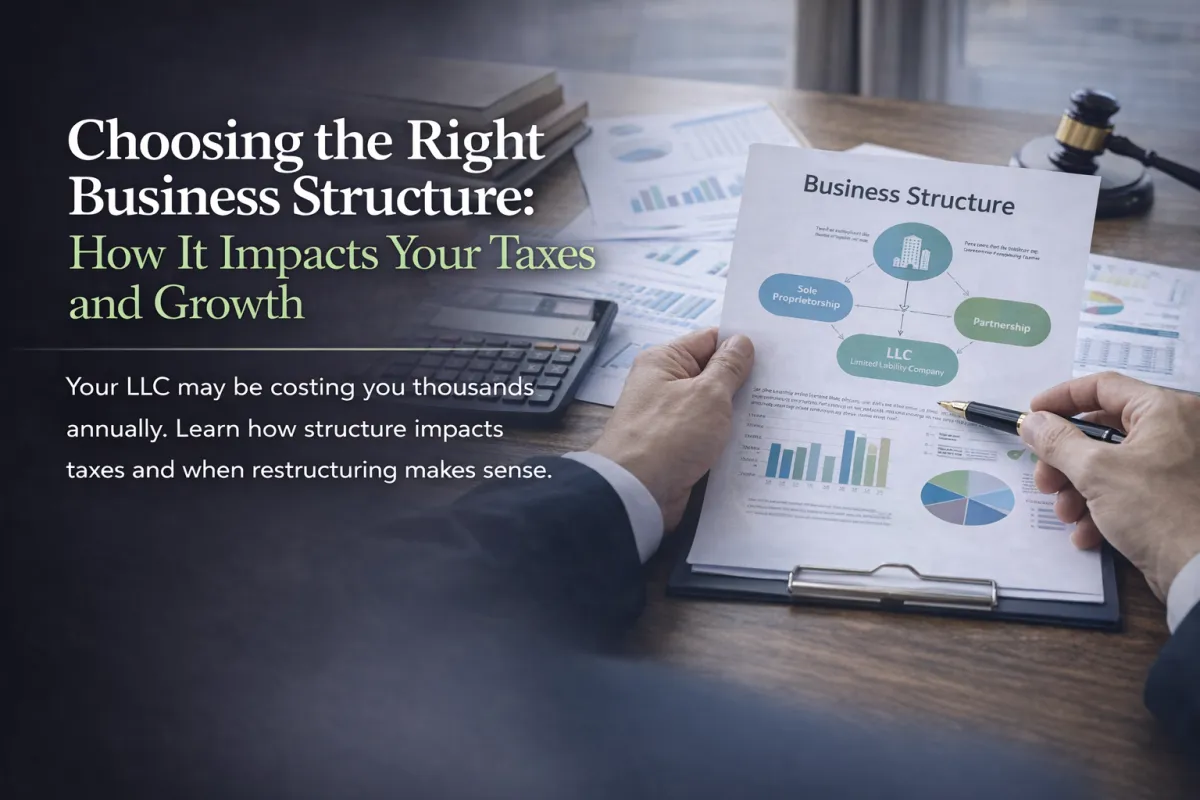
Choosing the Right Business Structure: How It Impacts Your Taxes and Growth
Choosing the Right Business Structure: How It Impacts Your Taxes and Growth
When you launched your business, someone likely advised you to form an LLC. It was simple, protective, and widely recommended. So you filed the paperwork and focused on building your company.
That was probably the right decision at the time.
The question worth examining now is whether it remains the right decision today.
The Hidden Cost of “Set It and Forget It”
Your business has evolved since its formation. Revenue has grown. Operations have matured. Your tax situation has become more complex.
Yet your entity structure the legal and tax framework underlying everything has likely remained unchanged.
For many business owners, this mismatch costs real money. The structure that made sense at $50,000 in profit can become increasingly expensive at $150,000, $250,000, and beyond.
And yet, most accountants never initiate this conversation. They file what exists rather than questioning what should exist.
Understanding Your Options
The LLC: Simplicity with Limitations
LLCs offer flexibility and minimal administrative requirements. However, by default, all profit passes through as self-employment income, subject to the full 15.3% employment tax.
At higher income levels, this simplicity can carry a substantial cost.
The S-Corporation: Strategic Tax Efficiency
An S-Corporation election allows you to split income between salary (subject to employment taxes) and distributions (which are not).
For a business owner with $200,000 in profit, proper S-Corp structuring can potentially generate $15,000–$20,000 in annual tax savings.
The trade-off is increased compliance: payroll administration, reasonable compensation requirements, and additional filings.
However, for businesses with consistent profits above $80,000–$100,000, the financial advantage often outweighs the added complexity.
The C-Corporation: Strategic Complexity
C-Corporations serve specific purposes such as businesses seeking institutional investment, retaining significant earnings at corporate tax rates, or pursuing certain estate planning strategies.
They can be powerful in the right circumstances, but are not suitable for most small businesses.
Why This Conversation Rarely Happens
Entity structure optimization is one of the highest-value activities in tax planning.
So why do most accountants never bring it up?
Because it requires a deep understanding of your business not just your books, but your operations, assets, and long-term goals.
It requires a relationship where your advisor understands where you’re going, not just where you’ve been.
The Lumenor Approach
Entity structure analysis is a standard part of how we work but it doesn’t happen in isolation.
We start by ensuring your books are accurate and building monthly management reports that provide true visibility into your business.
From there, we learn your operations, assets, and existing structure. We work with you to set short- and long term goals, then create a financial blueprint to support them.
Entity optimization is often part of that blueprint.
When restructuring makes sense, we guide the entire process from election filings to payroll setup, reasonable compensation planning, and ongoing compliance.
What This Really Means
A true financial partner doesn’t just ensure your taxes are filed correctly.
They continuously evaluate whether your business structure is optimized for where you’re going not just where you’ve been.
Ready for a Different Kind of Financial Partnership?
Schedule a complimentary 30-minute consultation to discover what’s possible:
SPANISH VERSION
Eligiendo la Estructura Empresarial Correcta: Cómo Impacta Tus Impuestos y Crecimiento
Cuando lanzaste tu negocio, alguien te aconsejó formar una LLC.
Era simple, protectora y lo que todos recomendaban.
Así que presentaste el papeleo y seguiste construyendo tu empresa.
Esa fue probablemente la decisión correcta en ese momento.
La pregunta que vale examinar es si sigue siendo la decisión correcta hoy.
El Costo Oculto de "Configurar y Olvidar"
Tu negocio ha evolucionado considerablemente desde su formación.
Los ingresos han crecido.
Las operaciones han madurado.
Tu situación fiscal se ha vuelto más sofisticada.
Sin embargo, tu estructura de entidad — el marco legal y fiscal subyacente a todo — probablemente ha permanecido congelada en su forma original.
Para muchos empresarios, este desajuste cuesta dinero real.
La estructura que tenía sentido a $50,000 de ganancia se vuelve cada vez más costosa a $150,000, $250,000 y más allá.
Sin embargo, la mayoría de los contadores nunca sacan esta conversación.
Presentan lo que existe en lugar de cuestionar lo que debería existir.
Entendiendo Tus Opciones
La LLC: Simplicidad con Limitaciones
Las LLC ofrecen flexibilidad y requisitos administrativos mínimos.
Sin embargo, por defecto, toda la ganancia pasa como ingreso de autoempleo, sujeta al 15.3% completo de impuesto de empleo.
En niveles de ingreso más altos, esta simplicidad conlleva un costo sustancial.
La S-Corporation: Eficiencia Fiscal Estratégica
La elección de S-Corp permite dividir ingresos entre:
Salario (sujeto a impuestos de empleo)
Distribuciones (que los evitan)
Para un empresario con $200,000 de ganancia, la estructuración adecuada de S-Corp puede generar $15,000–$20,000 en ahorros fiscales anuales.
La compensación involucra mayor cumplimiento:
Administración de nómina
Documentación de compensación razonable
Presentaciones adicionales
Pero para negocios con ganancia consistente por encima de $80,000–$100,000, las matemáticas típicamente favorecen este enfoque decisivamente.
La C-Corporation: Complejidad Estratégica
Las C-Corps sirven propósitos específicos:
Negocios buscando inversión institucional
Aquellos planeando retener ganancias significativas a tasas corporativas
Propietarios con objetivos particulares de planificación patrimonial
Poderosas en las circunstancias correctas, pero incorrectas para la mayoría de los pequeños negocios.
Por Qué Esta Conversación Rara Vez Ocurre
La optimización de estructura de entidad es una de las actividades de mayor valor en la planificación fiscal.
Entonces, ¿por qué la mayoría de los contadores nunca la mencionan?
Porque requiere conocimiento profundo de tu negocio:
No solo tus libros
Sino tus operaciones
Tus activos
Tus metas
Requiere el tipo de relación donde tu asesor entiende a dónde estás tratando de ir, no solo dónde has estado.
El Enfoque de Lumenor
El análisis de estructura de entidad es un componente estándar de cómo trabajamos.
Pero no ocurre aislado — fluye naturalmente de nuestro proceso.
Comenzamos poniendo tus libros en orden y creando reportes gerenciales mensuales que nos dan verdadera visibilidad de tu negocio.
De ahí:
Aprendemos tus operaciones
Analizamos tus activos
Evaluamos tus estructuras corporativas
Establecemos metas juntos — a corto y largo plazo.
Creamos un plan de acción.
La optimización de entidad frecuentemente es parte de ese plan.
Cuando la reestructuración tiene sentido, guiamos la transición completamente:
Presentaciones de elección
Establecimiento de nómina
Determinación de compensación razonable
Cumplimiento continuo
Esto es lo que significa tener un socio financiero estratégico:
Alguien perpetuamente preguntando si tu configuración está optimizada para a dónde vas — no solo si tus declaraciones están presentadas correctamente para dónde has estado.
¿LISTO PARA UNA ALIANZA FINANCIERA DIFERENTE?
Agenda una consulta gratuita de 30 minutos y descubre lo que es posible.