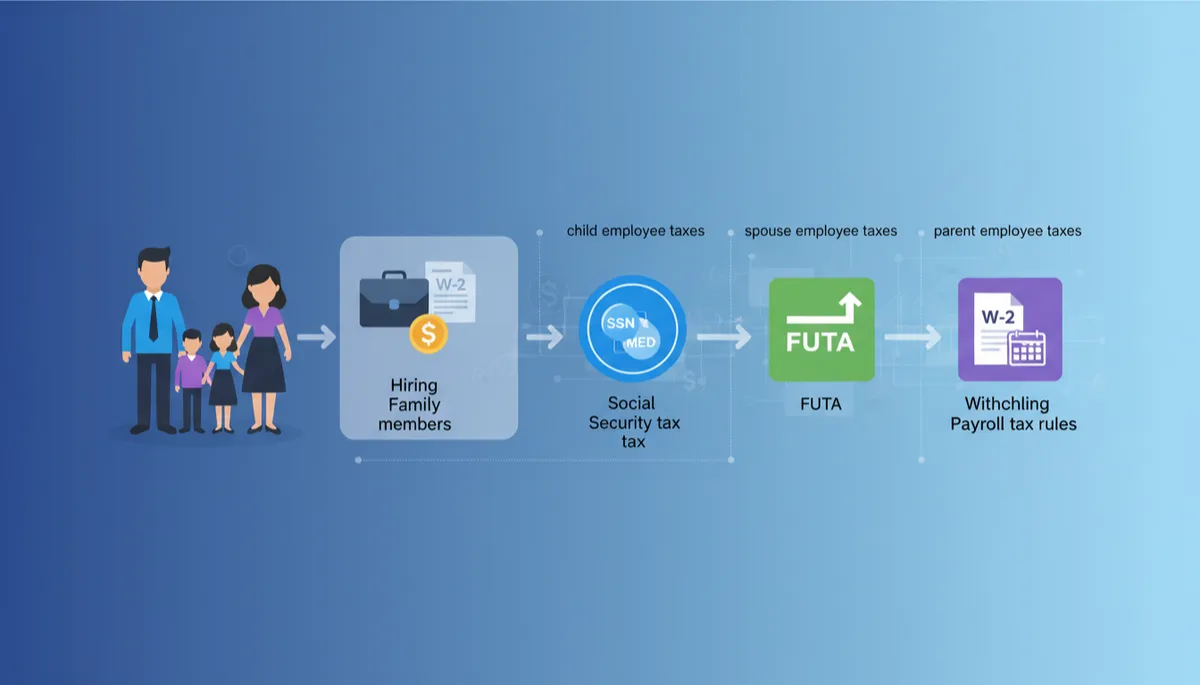
Impact of Hiring Family on Payroll Taxes
Payroll & Tax Compliance, Family Business Payroll
How Does Hiring a Family Member Affect Payroll Taxes?
Hiring a child, spouse, or parent can be a smart move for a family business—but it also triggers special federal payroll tax rules. Understanding how family-employee status affects income tax withholding, Social Security, Medicare, and FUTA helps you stay compliant and avoid IRS surprises.
Why Family Employee Payroll Taxes Are Different
When you are hiring family members, the IRS does not always treat them like unrelated employees. Family employee payroll taxes can vary based on:
The type of family relationship (child, spouse, parent)
Your business structure (sole proprietorship, partnership, corporation, or LLC)
The type of payroll tax (income tax withholding, Social Security tax, Medicare tax, FUTA)
No matter who you hire, you must treat them as a legitimate employee: real work, reasonable pay, and proper reporting—usually on a W-2 family employee form at year-end.
1. How Business Structure Impacts Family Payroll Taxes
The impact of business structure is one of the most important factors in family business payroll. The same child or spouse can be fully subject to Social Security and Medicare in one entity and partially exempt in another.
Sole Proprietorships and Single-Member LLCs
When you operate as a sole proprietor or a single-member LLC taxed as a sole proprietorship, special payroll tax rules apply to your child employee taxes and spouse employee taxes. These rules generally do not apply if you elect corporate taxation.
Partnerships and Multi-Member LLCs
If both parents are partners, a child working for the partnership is treated differently than a child working for one parent’s sole proprietorship. The IRS often views the child as working for the partnership as a whole, which can remove some of the exemptions available in a sole proprietorship.
Corporations (C Corps and S Corps)
Corporations are separate legal employers. Once your business is a C corporation or S corporation, most special family rules disappear. Children, spouses, and parents are generally treated like any other employee for Social Security tax, Medicare tax, and FUTA, regardless of ownership.

Choosing the right entity can change whether family wages are subject to FUTA.
2. The Importance of Documentation for Family Employees
Because family relationships can raise IRS scrutiny, documentation is critical. To support your payroll tax treatment, you should:
Keep a written job description for each family employee
Track hours worked, tasks performed, and pay rates just as you would for any other worker
Ensure compensation is reasonable for the work and age of the employee
Issue proper W-2 family employee forms and file all required payroll returns
💡 Pro Tip: Pay family members by check or direct deposit from the business account—never in cash—so you can clearly document wages and payroll tax withholdings.
3. Payroll Tax Rules for Children Working in the Business
Child employees can offer valuable tax planning opportunities when the business is structured correctly and the work is legitimate. Key federal rules for child employee taxes generally include:
In a sole proprietorship where a parent employs a child under age 18, wages are typically exempt from Social Security tax and Medicare tax.
Wages paid to a child under age 21 in a qualifying parent-owned sole proprietorship are usually exempt from FUTA.
In a corporation or partnership where both parents are owners, these child exemptions often do not apply; the child is treated like a regular employee for Social Security, Medicare, and FUTA.
Federal income tax withholding may still be required, depending on the child’s total income and Form W-4. Always follow child labor laws and pay only for real, age-appropriate work.
4. Payroll Tax Rules for Spouses on the Payroll
When you add your spouse to the payroll, the rules depend heavily on entity type. For spouse employee taxes:
In a sole proprietorship, a spouse’s wages are generally subject to Social Security tax and Medicare tax, but may be exempt from FUTA.
In a corporation, the spouse is treated like any other employee and subject to Social Security, Medicare, and FUTA.
Properly classifying the spouse as an employee (rather than a co-owner or contractor) and documenting hours and duties is essential to support deductions and payroll tax treatment.
5. Payroll Tax Rules for Parents Working in the Business
Hiring your mother or father can also affect payroll tax rules. For parent employee taxes in a child’s sole proprietorship:
Wages paid to a parent are typically subject to Social Security tax and Medicare tax.
However, certain wages may be exempt from FUTA when a child employs a parent, depending on the nature of the services.
As with other relatives, corporate structures usually remove these special exemptions and treat parents as regular employees for all federal payroll taxes.
6. Putting It All Together: Staying Compliant with Family Payroll
Whether you are hiring a teenager for summer help or bringing a spouse into management, family employees must be handled with the same rigor as any other worker. That means:
Applying the correct payroll tax rules for Social Security, Medicare, and FUTA based on relationship and entity type
Withholding income tax when required and reporting wages on a W-2 family employee form
Maintaining strong documentation to support that the pay is ordinary, necessary, and tied to real work
Because the rules for FUTA, Social Security tax, and Medicare tax can shift based on both relationship and business structure, many owners consult a payroll professional or tax advisor before adding relatives to the payroll. Doing so can help you capture available benefits while keeping your family business fully compliant.