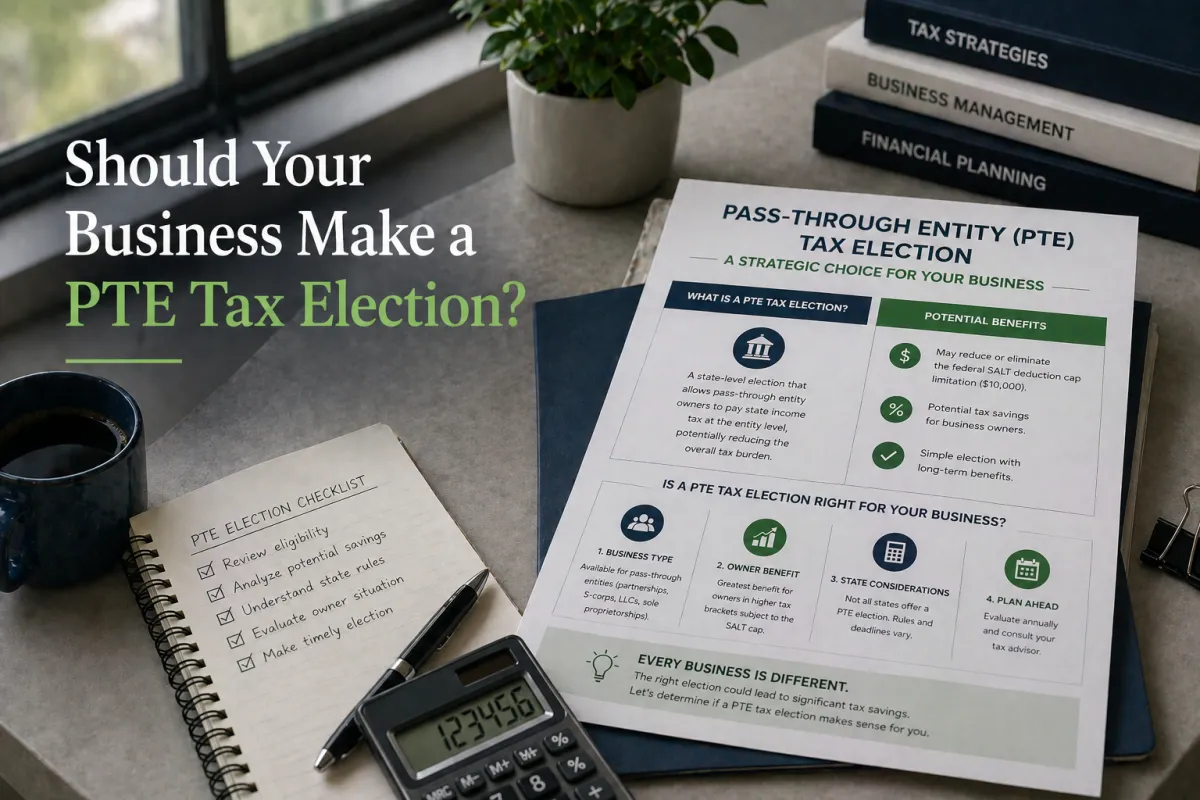
Should Your Business Make a PTE Tax Election?
Should Your Business Make a PTE Tax Election?
It can reduce taxes — or create complexity. The difference is strategy.
Pass-through entity (PTE) tax elections have gained attention as a potential way to mitigate state tax limitations, particularly those related to the SALT deduction cap.
According to analysis from Thomson Reuters, PTE elections can provide benefits — but only when applied correctly.
This is not a universal solution.
What a PTE Election Actually Does
A PTE election allows certain businesses — typically:
Partnerships
LLCs
S-Corps
To pay state income taxes at the entity level, rather than at the individual owner level.
Why this matters:
👉 In some cases, this allows businesses to bypass certain federal deduction limitations tied to individual taxpayers.
When a PTE Election May Make Sense
1. Businesses Affected by SALT Limitations
If your business operates in a state with higher income taxes, a PTE election may help reduce the impact of federal deduction caps.
2. Multi-Owner Structures
PTE elections are often more beneficial for:
Partnerships
Multi-member LLCs
Because the tax benefit can be distributed across multiple owners.
3. Stable and Predictable Profitability
Businesses with consistent income may find it easier to:
Plan for entity-level taxes
Maximize benefits from the election
When a PTE Election May Not Be Ideal
Not all businesses benefit.
1. State Rules Vary
Each state has its own:
Eligibility requirements
Tax rates
Filing rules
2. Added Administrative Complexity
PTE elections often require:
Additional filings
Adjustments to accounting processes
Coordination between federal and state reporting
3. Long-Term Impact Must Be Considered
What works in the current year may not be optimal in future years, especially if:
Tax laws change
Business structure evolves
What Most Business Owners Get Wrong
Assuming PTE is automatically beneficial
Following trends without analysis
Ignoring state-specific rules
Failing to evaluate long-term effects
This can result in:
👉 Minimal tax benefit
👉 Increased complexity
👉 Compliance issues
Strategic Insights
PTE elections are strategy-dependent, not universal
State rules determine actual benefit
Entity structure and ownership matter
Decisions should be based on data, not trends
Lumenor Advisory Perspective
Most businesses hear about PTE elections as a “tax-saving strategy.”
Lumenor approaches it differently:
We evaluate:
Whether it actually benefits your specific situation
How it fits into your overall tax strategy
Its long-term implications
Because:
👉 The goal is not to follow strategies
👉 The goal is to apply the right ones
Before making a PTE election, make sure it is the right move for your business.
Work with Lumenor Advisory Group to:
Analyze potential tax savings
Review state-specific rules
Build a strategy aligned with your business goals
PTE elections are not about following trends.
They are about making the right decision for your business.