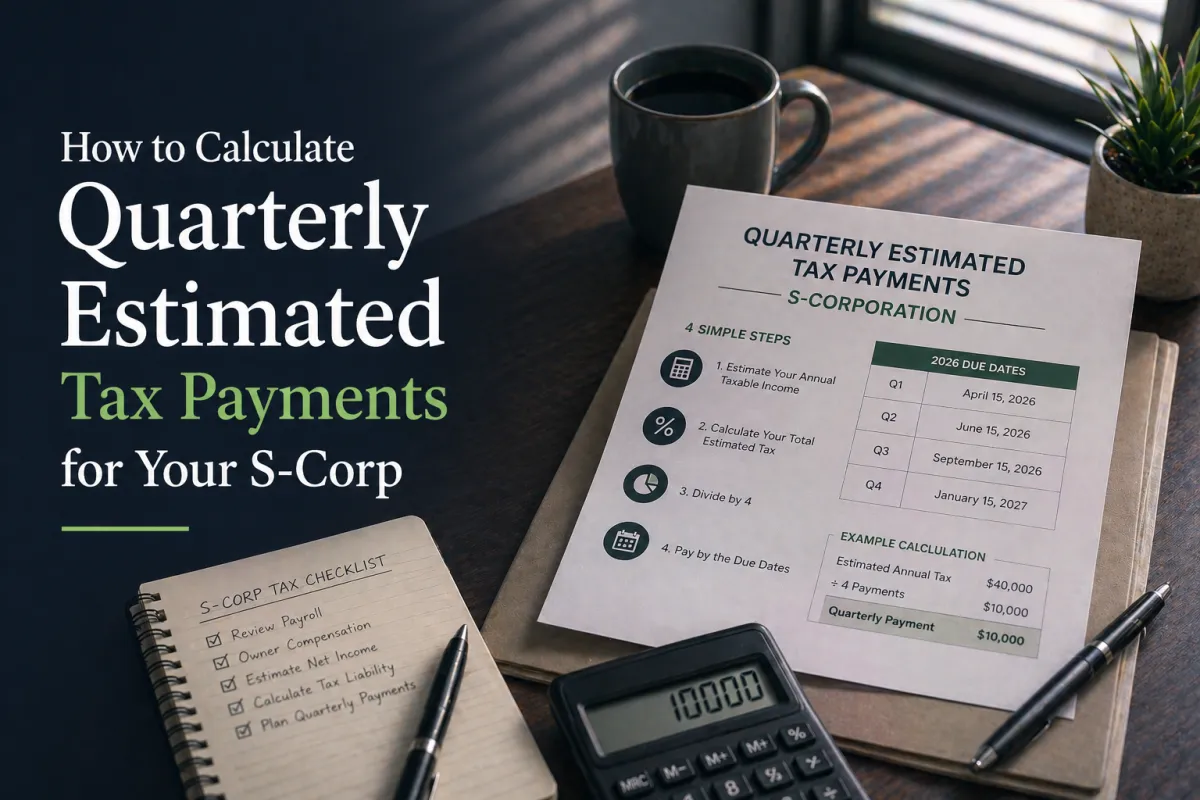
How to Calculate Quarterly Estimated Tax Payments for Your S-Corp
How to Calculate Quarterly Estimated Tax Payments for Your S-Corp
Stop guessing. Start planning with precision.
The Internal Revenue Service requires S-Corp owners to make quarterly estimated tax payments based on expected income.
However, most business owners:
Underestimate their liability
Overpay and hurt cash flow
Or guess without accurate data
The issue is not complexity — it is lack of structure.
Estimated Taxes Are a Planning System — Not a Guessing Game
Unlike traditional employees, S-Corp owners are responsible for managing their own tax payments throughout the year.
This includes:
Federal income tax
Self-employment-related obligations (where applicable)
State taxes
The challenge is that income is rarely fixed.
Without a system, estimated taxes become:
👉 Inconsistent
👉 Inaccurate
👉 Stressful
How Estimated Taxes Should Actually Be Calculated
1. Start With Projected Annual Income
Estimated taxes are based on what you expect to earn — not what you earned last year.
This requires:
Up-to-date bookkeeping
Revenue forecasting
Expense projections
Without accurate numbers, the estimate is flawed from the start.
2. Factor in Salary vs Distributions
For S-Corp owners:
Salary is subject to payroll taxes
Distributions are not (but still subject to income tax)
Balancing the two correctly affects:
Total tax liability
Compliance with IRS rules
3. Divide Into Quarterly Payments
The IRS typically requires payments four times per year.
Each payment should reflect:
Updated income projections
Adjustments from previous quarters
Static payments often lead to underpayment or overpayment.
4. Adjust Throughout the Year
Income changes. Your estimates should too.
Businesses that update quarterly:
Reduce penalty risk
Maintain better cash flow control
Avoid year-end surprises
What Most Business Owners Get Wrong
Using last year’s income as a baseline
Not updating estimates during the year
Ignoring changes in revenue
Guessing instead of calculating
These mistakes often result in penalties or inefficient use of cash.
Strategic Insights
Accurate bookkeeping is the foundation of accurate tax estimates
Forecasting reduces financial uncertainty
Quarterly adjustments improve control
Planning protects both cash flow and compliance
Lumenor Advisory Perspective
Estimated taxes should not feel like a burden.
They should feel predictable.
Lumenor helps business owners:
Build a structured quarterly tax system
Align payments with real financial performance
Maintain control over both taxes and cash flow
Because:
👉 Control comes from clarity
👉 And clarity comes from data
If you are still guessing your estimated taxes, you are taking unnecessary financial risk.
Work with Lumenor Advisory Group to:
Build a quarterly tax plan
Forecast your tax liability
Eliminate surprises
Estimated taxes are not the problem.
Lack of planning is.