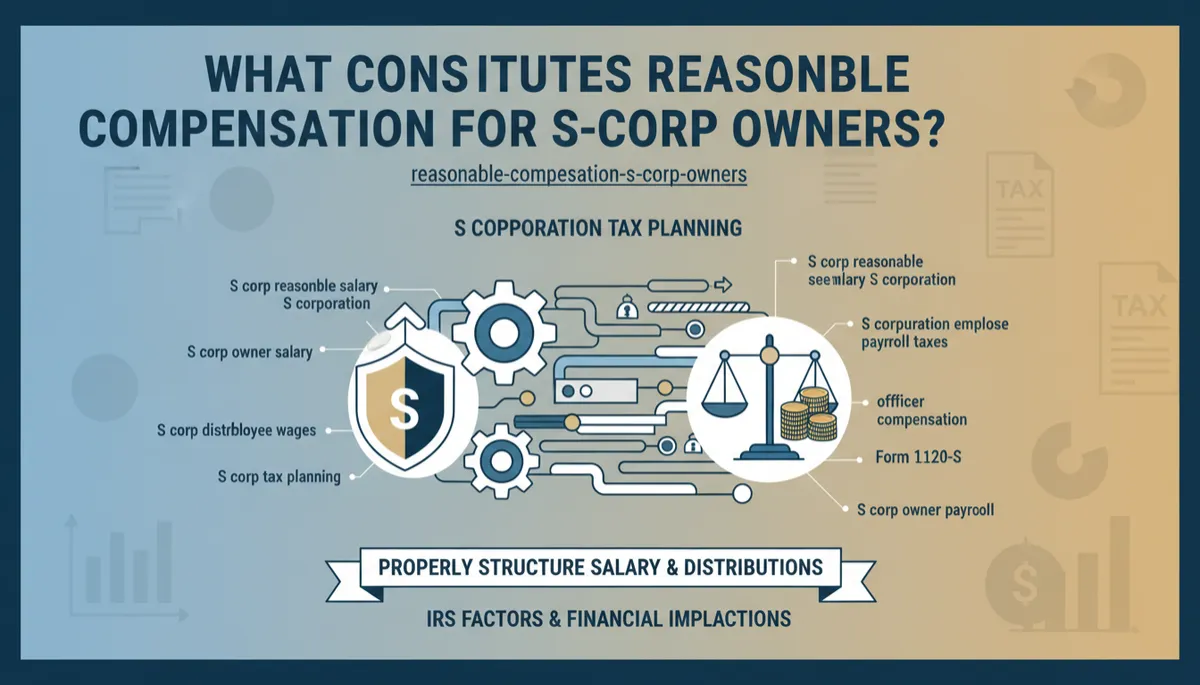
S-Corp Owner Salary: Reasonable Compensation Guide
S Corporation Tax Planning, S corp reasonable compensation, S corp owner salary
What Constitutes Reasonable Compensation for S-Corp Owners?
Understanding how to set a reasonable salary and distributions as an S-corporation owner is essential for minimizing risk, managing taxes, and keeping the IRS satisfied. This guide explains what “reasonable compensation” really means, the factors the IRS evaluates, and how your decisions affect both your current tax bill and long-term financial planning.
Why Reasonable Compensation Matters for S-Corp Owners
One of the biggest tax advantages of an S corporation is the ability to split income between S corp owner payroll (wages subject to payroll taxes) and S corp distributions (generally not subject to Social Security and Medicare taxes). However, this benefit comes with a clear condition: owner-employees must be paid a S corp reasonable compensation for the services they perform before taking additional profits as distributions.
If you pay yourself too little in shareholder employee wages and take most of your earnings as distributions, the IRS can reclassify those distributions as wages, assess back S corporation payroll taxes, penalties, and interest, and potentially flag your Form 1120-S for further scrutiny. Properly structuring salary and distributions is therefore not just a technicality—it is central to sound S corp tax planning.
💡 Pro Tip: Treat your reasonable salary S corporation decision as a risk-management step, not just a tax-saving tactic. A defensible number can save you from costly IRS disputes later.
How the IRS Thinks About Reasonable Salary for S Corporations
The tax code does not give a simple formula for S corp owner salary. Instead, the IRS looks at whether what you pay yourself is similar to what an unrelated employer would pay someone with your responsibilities in a comparable business. In audits, agents often rely on court cases, industry data, and a list of practical factors to judge if officer compensation is reasonable.
Key Factors the IRS Considers
Your role and duties: Are you the CEO, salesperson, bookkeeper, and operations manager all in one? The more critical your work, the higher your reasonable compensation should be.
Time devoted to the business: Full-time involvement generally calls for higher wages than a part-time advisory role, even with the same title.
Training and experience: Years of specialized expertise, licenses, or certifications support higher shareholder employee wages.
Industry and geographic norms: What do similar businesses in your region pay for comparable positions? Salary surveys and job postings can help document this.
Company size and profitability: A young S-corp barely breaking even cannot support the same salary as an established, highly profitable firm. Your wage should still be reasonable in relation to total profits.
Compensation of non-owner employees: If staff members with fewer responsibilities earn close to your pay, it may signal that your own compensation is too low.
The IRS may also examine the ratio of wages to distributions. Extremely low wages with very high S corp distributions can be a red flag. Thoughtful documentation—such as salary surveys, written job descriptions, and board minutes approving officer compensation—strengthens your position if questions arise.

Documented salary benchmarks and board approvals help defend your compensation in an audit.
Balancing Salary and Distributions: Financial and Tax Implications
Structuring your mix of wages and distributions is at the heart of S corp tax planning. Your salary as a shareholder-employee is subject to income tax and S corporation payroll taxes (Social Security and Medicare). Distributions, on the other hand, typically avoid payroll taxes but are still reported as pass-through income from Form 1120-S on your personal return.
Paying yourself too much salary may mean you are overpaying payroll taxes and leaving less cash in the business. Paying yourself too little, however, increases audit risk and can result in reclassified income, back taxes, and penalties. The goal is to land in a reasonable middle ground: a defensible reasonable salary S corporation owners can justify, with remaining profits taken as distributions when appropriate.
Beyond Taxes: Cash Flow, Retirement, and Risk
Cash flow planning: Regular payroll provides predictable income, while distributions can be timed around cash surpluses or major expenses.
Retirement savings: Many retirement plan contributions are tied to S corp owner payroll, not distributions, so underpaying yourself may limit what you can save in tax-advantaged accounts.
Social Security benefits: Wages subject to Social Security taxes help build your future benefit; years of very low reported earnings can reduce your eventual payout.
Risk management: A clear, well-documented compensation policy supports your position in lender reviews, potential investor discussions, and any IRS examination.
Putting It All Together for Your S-Corp
Defining S corp reasonable compensation is not about finding the single perfect number; it is about arriving at a well-supported range and documenting how you chose your S corp owner salary. Consider your role, market data, and profitability, then set wages that a neutral third party would view as fair. Use distributions to share remaining profits—without letting them overshadow your base pay.
Because the rules are nuanced and your situation is unique, it is wise to work with a tax professional who understands S corporation tax planning. Together, you can design a compensation strategy that balances tax efficiency, compliance, and long-term financial health—while keeping your Form 1120-S and officer compensation well within the IRS’s comfort zone.
URL slug: reasonable-compensation-s-corp-owners