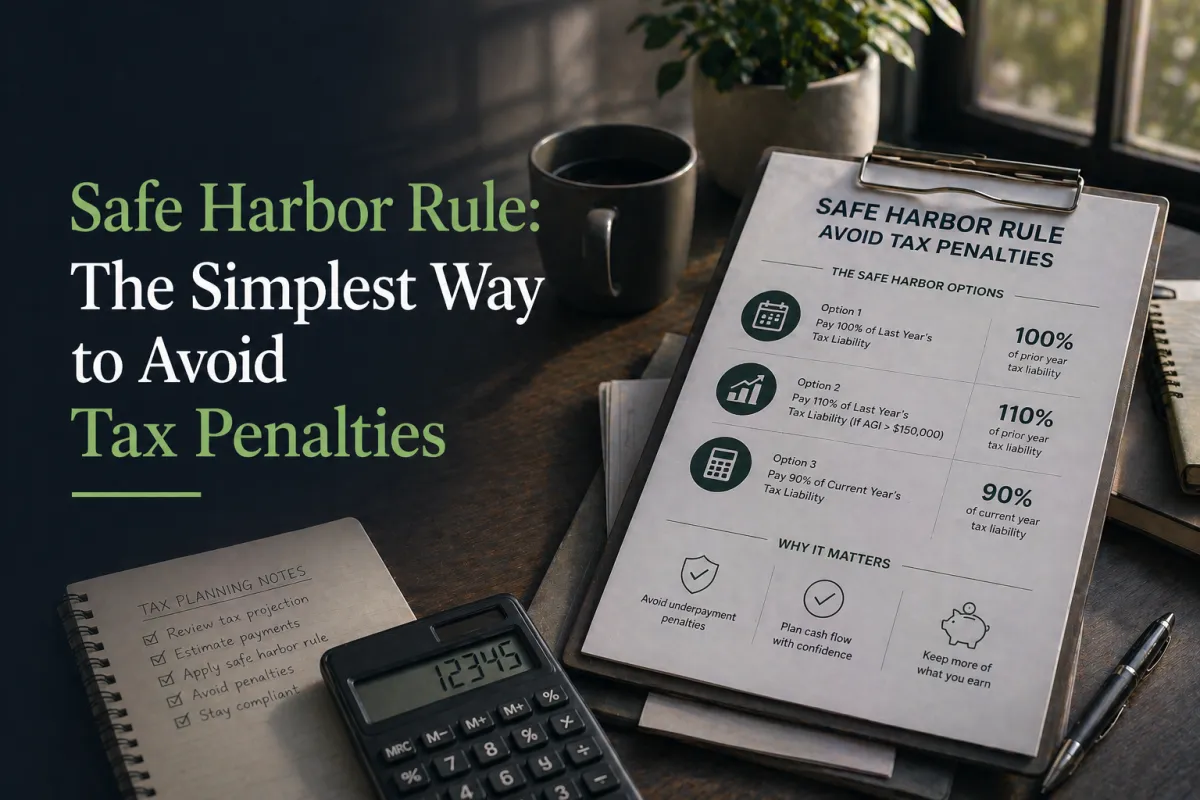
Safe Harbor Rule: The Simplest Way to Avoid Tax Penalties
Safe Harbor Rule: The Simplest Way to Avoid Tax Penalties
It’s not just how much you pay — it’s when and how you pay it.
The Internal Revenue Service imposes penalties when taxes are underpaid throughout the year.
However, the safe harbor rule provides a way for businesses to avoid these penalties — even if their final tax bill is higher than expected.
The key is understanding how the rule works and applying it correctly.
Why Timing Matters More Than Most Business Owners Think
Many business owners believe that as long as they pay their taxes by year-end, they are compliant.
This is not always true.
The IRS evaluates:
How much tax you paid
When you paid it
Even if your total tax is fully paid by the end of the year, you may still face penalties if payments were not made properly throughout the year.
This is where the safe harbor rule becomes critical.
How the Safe Harbor Rule Works
1. What Safe Harbor Means
Safe harbor is a guideline that allows taxpayers to avoid underpayment penalties if they meet certain minimum payment thresholds during the year.
These thresholds are typically based on:
A percentage of your current year tax liability
orA percentage of your previous year tax liability
2. Why It Matters for Business Owners
For businesses with:
Fluctuating income
Seasonal revenue
Rapid growth
It can be difficult to predict exact tax liability.
Safe harbor provides a buffer — allowing you to remain compliant even if your estimates are not perfectly accurate.
3. The Risk of Ignoring Safe Harbor
Without applying safe harbor rules, businesses may:
Underpay during the year
Face penalties despite paying in full later
Experience unexpected financial strain
What Most Business Owners Get Wrong
Assuming year-end payment is enough
Not understanding timing requirements
Ignoring safe harbor thresholds
Failing to adjust quarterly payments
These mistakes are common — and avoidable.
Strategic Insights
Timing of tax payments is as important as total amount
Safe harbor reduces penalty risk
Quarterly planning improves compliance
Predictability reduces financial stress
Lumenor Advisory Perspective
Tax penalties are rarely about lack of effort.
They are about lack of structure.
Lumenor helps business owners:
Align estimated payments with safe harbor rules
Build predictable tax systems
Eliminate unnecessary penalties
Because:
👉 Compliance should not be uncertain
👉 It should be controlled and predictable
If you are unsure whether your payments meet safe harbor requirements, you may be exposed to avoidable penalties.
Work with Lumenor Advisory Group to:
Review your estimated tax payments
Apply safe harbor strategies
Build a compliant payment system
Tax penalties are not random.
They are the result of timing and structure.