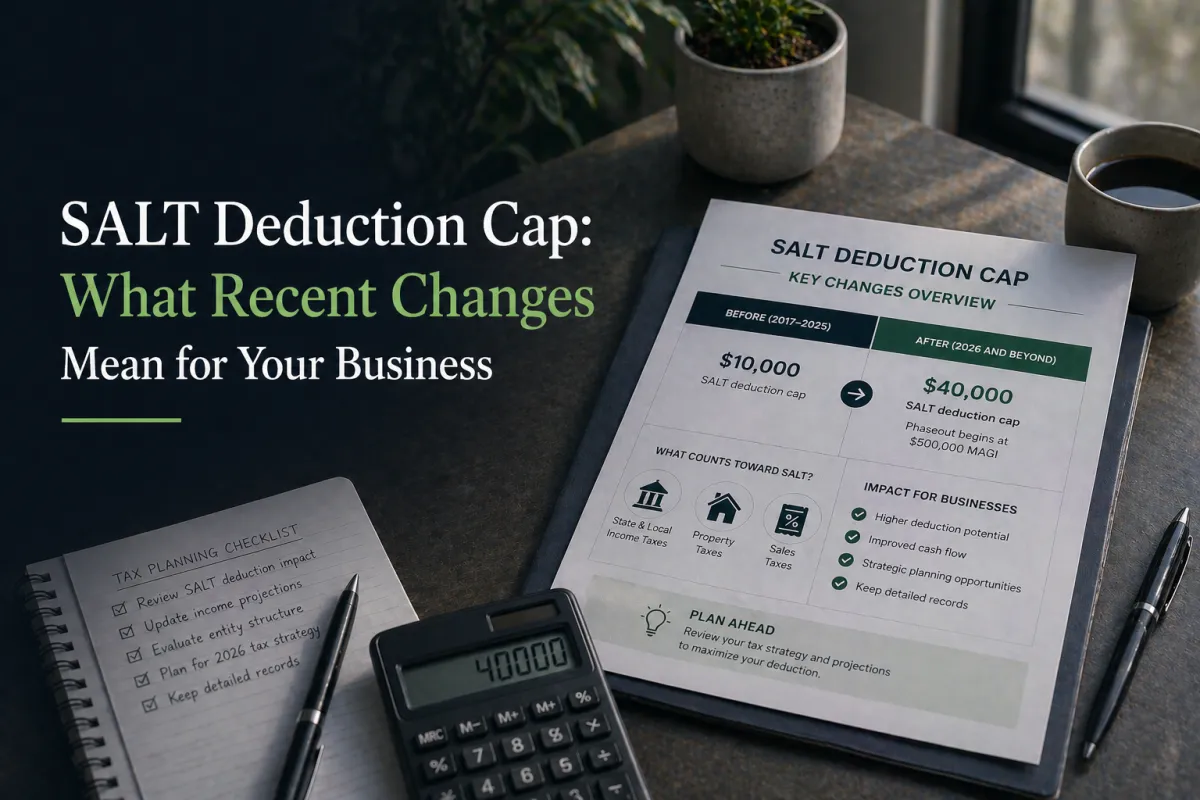
SALT Deduction Cap: What Recent Changes Mean for Your Business
SALT Deduction Cap: What Recent Changes Mean for Your Business
State taxes don’t stay at the state level — they affect your federal strategy too.
The State and Local Tax (SALT) deduction cap remains one of the most impactful limitations for business owners, particularly those operating in higher-tax states.
Ongoing analysis from firms like Thomson Reuters shows that SALT-related planning continues to be a critical part of overall tax strategy.
Why the SALT Cap Still Matters
The SALT deduction allows taxpayers to deduct certain state and local taxes on their federal return.
However, the deduction is currently limited (capped), which reduces the total amount that can be claimed.
For business owners, this creates a challenge:
👉 You may be paying significant state taxes
👉 But only deducting a limited portion federally
This disconnect increases your effective tax burden.
How the SALT Cap Impacts Business Owners
1. Higher Effective Tax Rates
When deductions are limited, taxable income increases.
This means:
More income is exposed to federal tax
Total tax liability rises
2. Pass-Through Entities Are Affected Differently
Owners of:
LLCs
Partnerships
S-Corps
May experience SALT limitations differently depending on structure.
Some states allow entity-level strategies that can help mitigate the cap.
3. Planning Opportunities Exist — But Require Analysis
Strategies such as pass-through entity (PTE) elections may help reduce SALT limitations in certain cases.
However:
Rules vary by state
Not all businesses benefit
Long-term impact must be considered
What Most Business Owners Get Wrong
Assuming SALT is a fixed limitation with no planning options
Not reviewing entity structure
Ignoring state-specific strategies
Applying generic advice without analysis
These mistakes can lead to paying more tax than necessary.
Strategic Insights
SALT is not just a deduction — it is a structural planning issue
Entity choice can influence tax outcomes
State-level strategies may reduce federal impact
Planning must consider both short-term and long-term effects
Lumenor Advisory Perspective
Most businesses treat SALT as a limitation.
Lumenor treats it as a planning opportunity.
We help business owners:
Evaluate structure and elections
Identify state-specific strategies
Align federal and state tax planning
Because:
👉 The way your business is structured determines how much you keep
If you have not reviewed how SALT affects your business, you may be missing opportunities to reduce your tax burden.
Work with Lumenor Advisory Group to:
Evaluate your current structure
Analyze SALT impact
Explore strategic options
SALT is not just a limitation.
It is a signal to review your strategy.